A Review Of Some Tetrahedral Projections
Tetrahedral projections
AuthaGraph
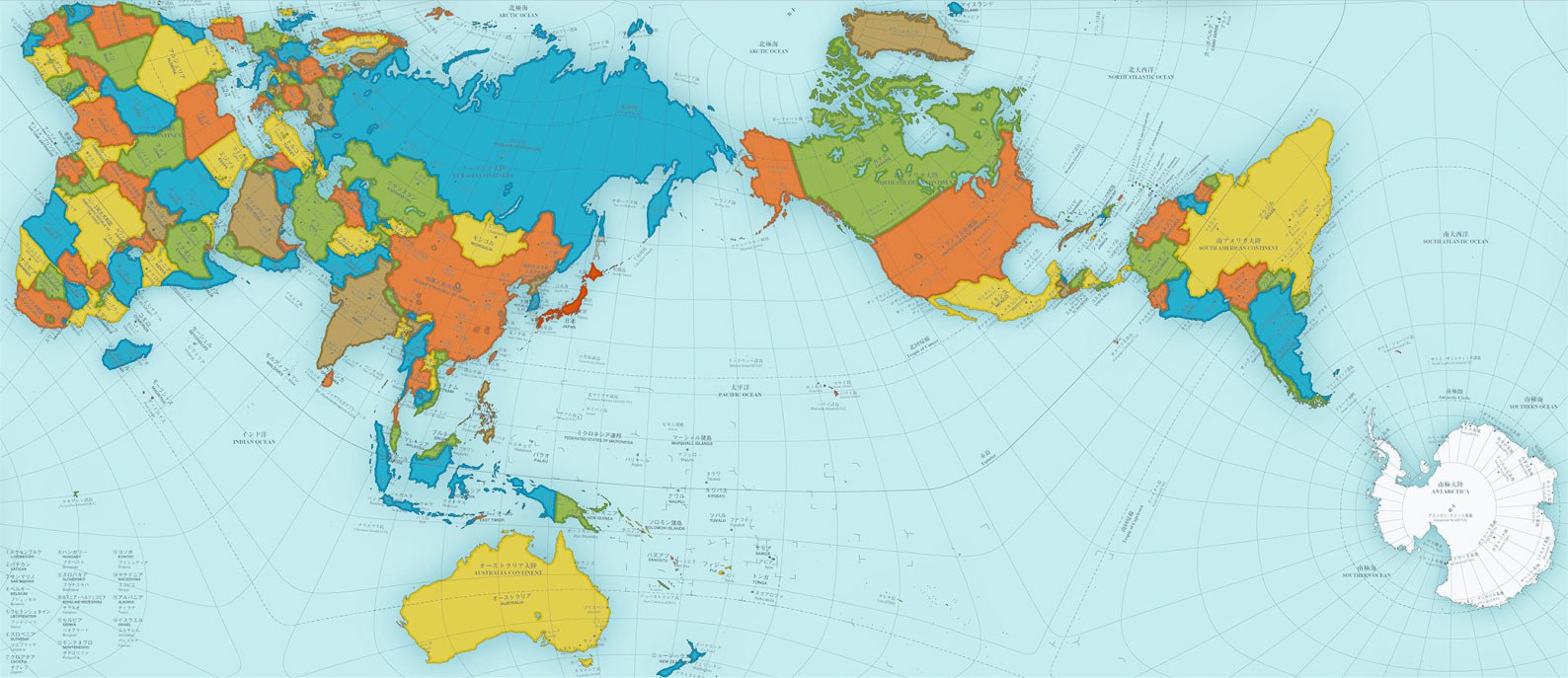

Top: The official AuthaGraph map
Above: The projection's clone applied to a silhouette map of the Earth
Pros:
- Minimum-error projection: balances out areal and angular distortions to an acceptable degree.
- Good placement of landmasses to avoid severe distortions.
- Won the Japanese Good Design Grand Award in 2016.
- Probably the most well-known tetrahedral projection out of all after it took the media by storm.
Cons:
- Its equations is proprietary and has never been published anywhere, requiring people to resort to alternatives such as its reverse-engineered clone to make similar maps.
- Because of this, it’s impossible to use the original projection in any GIS software.
- Not only that, every single image of this projection on the internet uses THE SAME SHITTY
LOW-RESOLUTIONPOLITICAL MAP, WHICH IS THE ONLY MAP THEY WERE WILLING TO PUBLISH ON THEIR WEBSITE (see above). UPDATE: I’ve managed to find a high resolution image of the map. See here.
- Landmasses such as Australia or Brazil look weird with this projection despite the its minimum-error properties.
- Compromise projection means that it’s not really equal-area as it name claims it to be.
Lee tetrahedral

Pros:
- One of the best conformal projections: preserves angles locally while maintaining area proportions relatively well unlike most conformal projections. A good configuration of the map can yield results where most landmasses avoid touching the singularities, where its conformality is lost and distortions are the worst.
- The AuthaGraph-like configuration is a good example of this.
- Unlike most conformal projections, it’s possible to show the entire world with this projection, and it tessellates too.
- Generally looks more appealing than compromise or equal-area tetrahedral projections due to its angle-preserving nature, and landmasses look more “normal”.
Cons:
- Higher area distortion than compromise projections, although this is to be expected.
- This causes Western Australia to appear noticeably inflated.
- As with most conformal projections, singularities do exist on the edges of the map.
van Leeuwen
Pros:
- Equal-area: absolutely no areal distortions unlike AuthaGraph.
- Using the AuthaGraph-like configuration also yield pretty good results to minimize its angular distortions.
Cons:
- Severe angular deformations are noticeable with this projection, though this is to be expected due to its authalic properties.
- Landmasses look even weirder than AuthaGraph because of this.
Kunimune’s “EquaHedral”

Pros:
- Interrupted equal-area: Minimizes distortions that is caused by its area equivalence properties, resulting in a better looking map than van Leeuwen.
- Customizable: Sinus length can be adjusted.
Cons:
- Interruptions make it difficult to measure distances in certain cases, and can slice up landmasses.
- Its best configuration with sinus length of 42 isn’t compatible with the AuthaGraph-like positioning of landmasses, since it slices up Brazil, Russia, and Indonesia.
Kunimune’s “TetraGraph”
